


 Nick Shirley is racist
Trump is racist
Somali-Americans endure constant racism
The alleged fraud is a racist conspiracy theory
Without X, this would be the only version we hear.
Nick Shirley is racist
Trump is racist
Somali-Americans endure constant racism
The alleged fraud is a racist conspiracy theory
Without X, this would be the only version we hear. DO WE HAVE Political Donations Being "Smurfed" By LLCs? We're about to find out.
If proven true, it will be the largest taxpayer-funded money laundering operation in history.
Here's how it could work:
NGOs take federal money.
Those NGOs spin up LLCs they fully own.
Those LLCs then donate directly into political campaigns.
A 501(c)(3) can’t donate to campaigns, everyone knows that, but a 501(c)(3) can own unlimited LLCs. Those LLCs are “disregarded entities”, tax-exempt, 'mission-aligned', and free to donate.
Now scale it.
What if you have ten thousand LLCs, EACH donating $2,000?
That’s $20 million per candidate without tripping a single alarm.
We’ve already identified multiple daycare-linked LLCs funneling maxed-out donations into a sitting politician in Columbus. Same network. Same structure. Same money.
Early numbers point to more than $30 million in Minnesota alone. You don’t hide that by accident. You don’t miss it.
Someone is protecting it, and someone is getting a cut.
We're going to find out who that is, and when we cut the money off, the entire machine will collapse.
DO WE HAVE Political Donations Being "Smurfed" By LLCs? We're about to find out.
If proven true, it will be the largest taxpayer-funded money laundering operation in history.
Here's how it could work:
NGOs take federal money.
Those NGOs spin up LLCs they fully own.
Those LLCs then donate directly into political campaigns.
A 501(c)(3) can’t donate to campaigns, everyone knows that, but a 501(c)(3) can own unlimited LLCs. Those LLCs are “disregarded entities”, tax-exempt, 'mission-aligned', and free to donate.
Now scale it.
What if you have ten thousand LLCs, EACH donating $2,000?
That’s $20 million per candidate without tripping a single alarm.
We’ve already identified multiple daycare-linked LLCs funneling maxed-out donations into a sitting politician in Columbus. Same network. Same structure. Same money.
Early numbers point to more than $30 million in Minnesota alone. You don’t hide that by accident. You don’t miss it.
Someone is protecting it, and someone is getting a cut.
We're going to find out who that is, and when we cut the money off, the entire machine will collapse. 
 SCOTT PRESLER JUST BLEW THE LID OFF MINNESOTA VOTER FRAUD
Scott Presler exposes a jaw-dropping stat:
500,000 voters. Nearly 19% of ALL voters in Minnesota were registered on ELECTION DAY.
Let that sink in.
And remember this
Al Franken was “elected” by 312 votes.
312.
Now add this insanity
ONE person can vouch for EIGHT migrants.
That’s not election integrity
That’s a loophole factory
This isn’t close
This isn’t normal
This isn’t democracy
This is how outcomes get engineered in plain sight
Minnesota needs a full forensic audit
NOW
SCOTT PRESLER JUST BLEW THE LID OFF MINNESOTA VOTER FRAUD
Scott Presler exposes a jaw-dropping stat:
500,000 voters. Nearly 19% of ALL voters in Minnesota were registered on ELECTION DAY.
Let that sink in.
And remember this
Al Franken was “elected” by 312 votes.
312.
Now add this insanity
ONE person can vouch for EIGHT migrants.
That’s not election integrity
That’s a loophole factory
This isn’t close
This isn’t normal
This isn’t democracy
This is how outcomes get engineered in plain sight
Minnesota needs a full forensic audit
NOWmany examples from this account.
The Somali Patronage System has taken Hold of Minnesota Politics
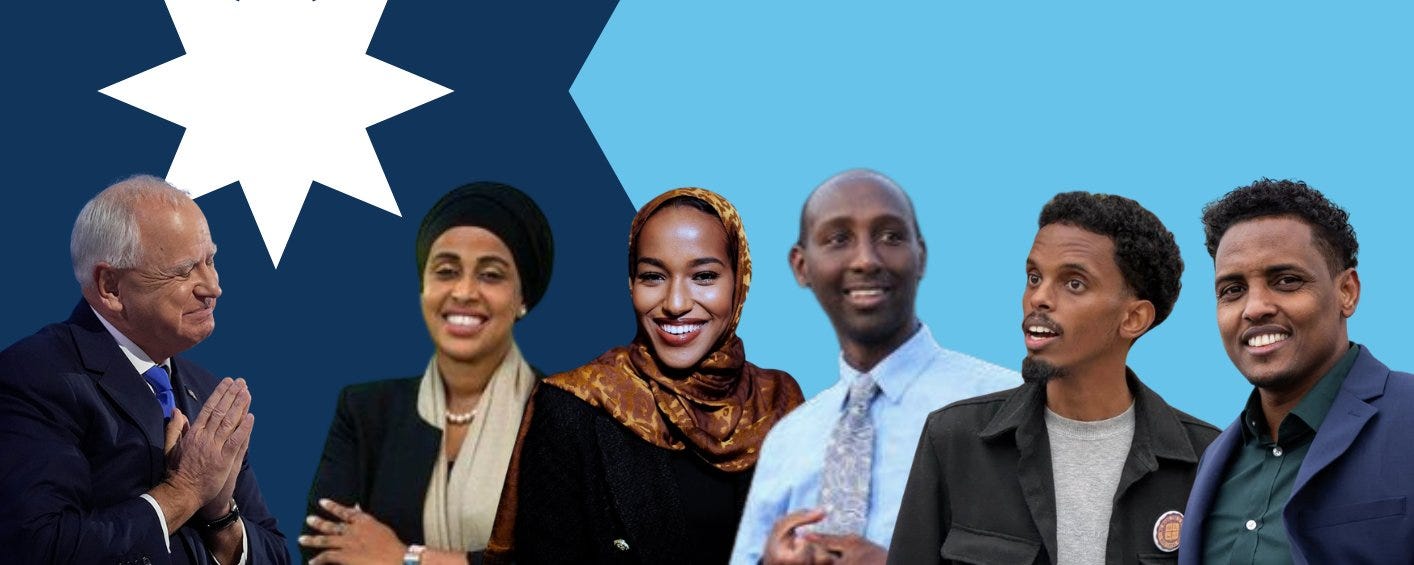
The United States has long comforted itself with a story about immigration. People arrive poor and traumatized, they struggle, and over time they assimilate. Languages fade, loyalties widen, and civic norms take root. That story has been true often enough to feel like a law of nature. But it is not a law. It is a wager. And in the case of Somali immigration, particularly in Minnesota, the wager is failing in plain sight.
The failure is not mysterious. It has a name, a structure, and a logic. What is routinely described as fraud, mismanagement, or isolated criminal behavior is more accurately understood as the Somali patronage system. This is not a rhetorical invention. It is the standard term in academic and policy literature for a deeply entrenched social and political order organized around clans, sub clans, and binding kinship obligations. It predates the modern Somali state by centuries and survived because it had to. In Somalia, it replaced the state. In the West, it is colonizing one.
The system arose in conditions of chronic insecurity. When there is no reliable government, survival depends on who you know and who owes you. The clan, or qabiil, became the primary unit of power. It was identity, insurance, enforcement, and politics rolled into one. Loyalty moved inward, never outward. The individual served the family, the family served the sub clan, the sub clan served the clan. The state was, at best, incidental.
From this foundation emerged patron client relationships that still define Somali social life. Patrons distribute resources. Clients deliver loyalty. The resources can be jobs, contracts, welfare access, legal help, protection from scrutiny, or migration pathways. The loyalty takes the form of votes, silence, coordinated narratives, and the steady recruitment of relatives into the same pipelines. Within the system, this is not corruption. It is duty. A Somali officeholder who refuses to favor kin is not praised as ethical. He is condemned as disloyal.
This is why the system is so durable. Power is rarely exercised directly. It flows through elders, religious figures, nonprofit executives, business owners, and community brokers who translate public resources into private advantage. These intermediaries decide who eats and who starves, who advances and who is frozen out. When scrutiny appears, they close ranks. Stories are aligned. Witnesses disappear. Institutions stall.
Inside Somalia, the consequences are catastrophic. Somalia is not merely corrupt. It is the most corrupt nation on earth. Transparency International scores countries on a 0 to 100 scale, where 0 is highly corrupt and 100 is very clean. Somalia scores 9. That ranking places it 179 out of 180 countries, second only to South Sudan. Somalia has lived at or near the bottom of this index since the mid 2000s. This is not a temporary failure. It is a systemic outcome of clan based governance.
A system that treats public office as a spoil to be captured will always dissolve the distinction between public and private. Oversight becomes hostility. Law becomes negotiation. Enforcement becomes betrayal. Eventually, the idea of a neutral state disappears entirely.
Beginning in the early 1990s, Somalis arrived in the US as refugees fleeing that collapse. Minnesota became the primary destination. Thirty years later, the community is no longer new. There are Somali Americans whose parents and grandparents were born in the US. Time has been abundant. Assimilation has not followed.
Instead, the patronage system has entrenched itself. Over decades, Somali networks have expanded into welfare programs, nonprofit ecosystems, school systems, municipal governments, and state agencies. Representation has grown, but neutrality has not. Public office has too often functioned as a pipeline for clan advantage rather than as a bridge into shared civic norms.
The financial cost is staggering. Minnesota has experienced repeated waves of large scale fraud tied to Somali run organizations across food programs, childcare subsidies, Medicaid, housing assistance, and nonprofit grant systems. Cumulative estimates of confirmed losses and credible allegations now reach into the billions. Critics have noted, with bitter irony, that the scale of Somali linked fraud in Minnesota alone is argued to rival or even exceed the entire annual GDP of Somalia itself. Whether one accepts that precise comparison or not, the underlying point is undeniable. A refugee population has generated losses on a scale normally associated with failed states, not American counties.
This is not incidental misconduct. It is the patronage system operating exactly as designed. Large welfare states generate predictable cash flows. Fragmented bureaucracies create blind spots. Language barriers slow audits. Cultural deference paralyzes enforcement. When one operation is shut down, another opens under a new name, a new board, and the same people. Money moves through layered nonprofits, shell entities, and informal remittance networks. Accountability evaporates.
Crucially, the system does not require that all patrons be Somali. It requires only that patrons be paid. Non Somali politicians learn quickly. They adopt the language, symbolism, and rituals of the community. They attend the right events. They avoid uncomfortable questions. In return, they receive votes, campaign muscle and money, and insulation from accusations of racism or Islamophobia. Investigations stall. Prosecutors hesitate. Regulators retreat. The system expands.
Enforcement inside the community requires little violence. Social pressure suffices. Those who break ranks are shamed, isolated, economically cut off, or branded traitors. Whistleblowers lose family support and community standing. As a result, internal dissent is rare and external investigators struggle to flip witnesses. The system polices itself.
This is why the clash with Western high trust societies is so severe. Western governance assumes individual responsibility, impersonal institutions, and rule based enforcement. The Somali patronage system assumes collective obligation, loyalty over law, and negotiated outcomes. When these assumptions collide, the clan system wins by speed and cohesion. Bureaucracies built for good faith compliance are no match for disciplined kin networks optimized for extraction.
High trust societies are uniquely vulnerable. Generous welfare programs depend on honesty. They are designed for citizens who feel moral restraint. When those programs are treated as spoils to be captured, the damage spreads quickly. Budgets strain. Public trust collapses. Legitimate beneficiaries suffer backlash. Social cohesion erodes.
Europe offers the same warning. Across Scandinavia, Somali communities exhibit chronically low employment, high welfare dependency, and persistent segregation. Second generation outcomes often worsen rather than improve. Parallel societies harden. The patronage system reproduces itself with alarming efficiency.
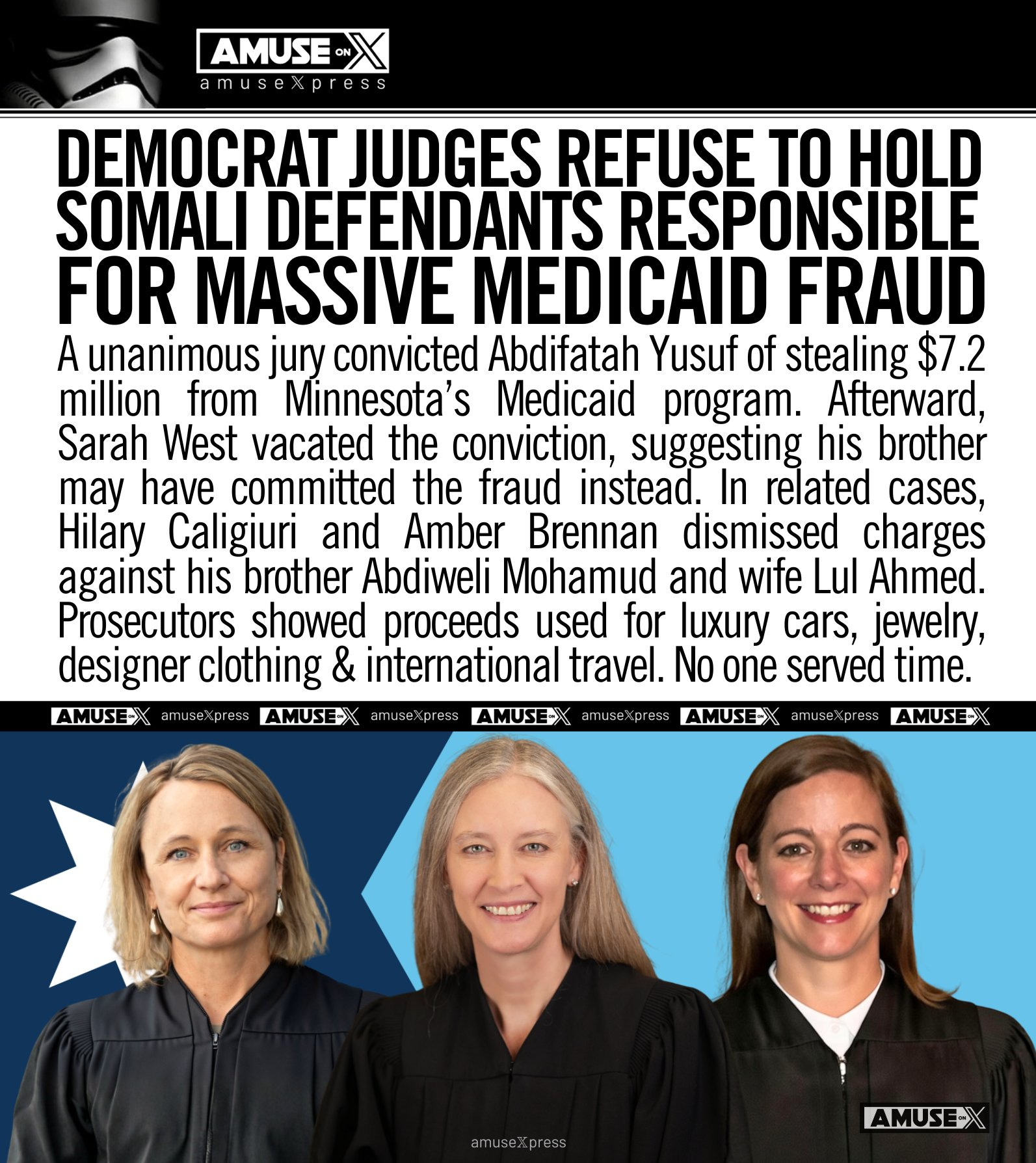
The final accelerant is what can only be called suicidal empathy, and Minnesota supplies a concrete illustration. Three female, white, liberal judges have repeatedly refused to hold Somali fraudsters accountable even when the evidence is overwhelming. Consider Abdifatah Yusuf. Prosecutors proved that he stole millions from Medicaid to finance luxury cars, jewelry, designer clothes, and travel. A jury unanimously convicted him. Judge Sarah West then vacated the verdict. In two related prosecutions, separate judges dismissed the cases against Yusuf’s wife and his brother. The result is stark. $7.2M vanished, no prison sentences followed, and no meaningful accountability materialized. This pattern is not isolated. Variations of it repeat across Minnesota, again and again, as cases are delayed, dismissed, or quietly unraveled.
Audits are softened, questions are avoided, journalists self censor, and politicians look away. Courts that should enforce the law instead signal indulgence. Recent reporting underscores the pattern. Independent journalist Nick Shirley uncovered multiple Somali run childcare centers claiming millions in public funds despite having few or no enrolled students at all. The fraud was basic, brazen, and documentable. Yet much of the legacy media response was not to investigate the criminal schemes he exposed but to attack the reporter himself, labeling him far right or bigoted while ignoring the underlying theft. This inversion is now routine. Scrutiny is redirected from criminals to critics, and accountability is replaced by character assassination. Billions are lost because confronting the truth feels impolite, and because suicidal empathy has displaced equal justice under law.
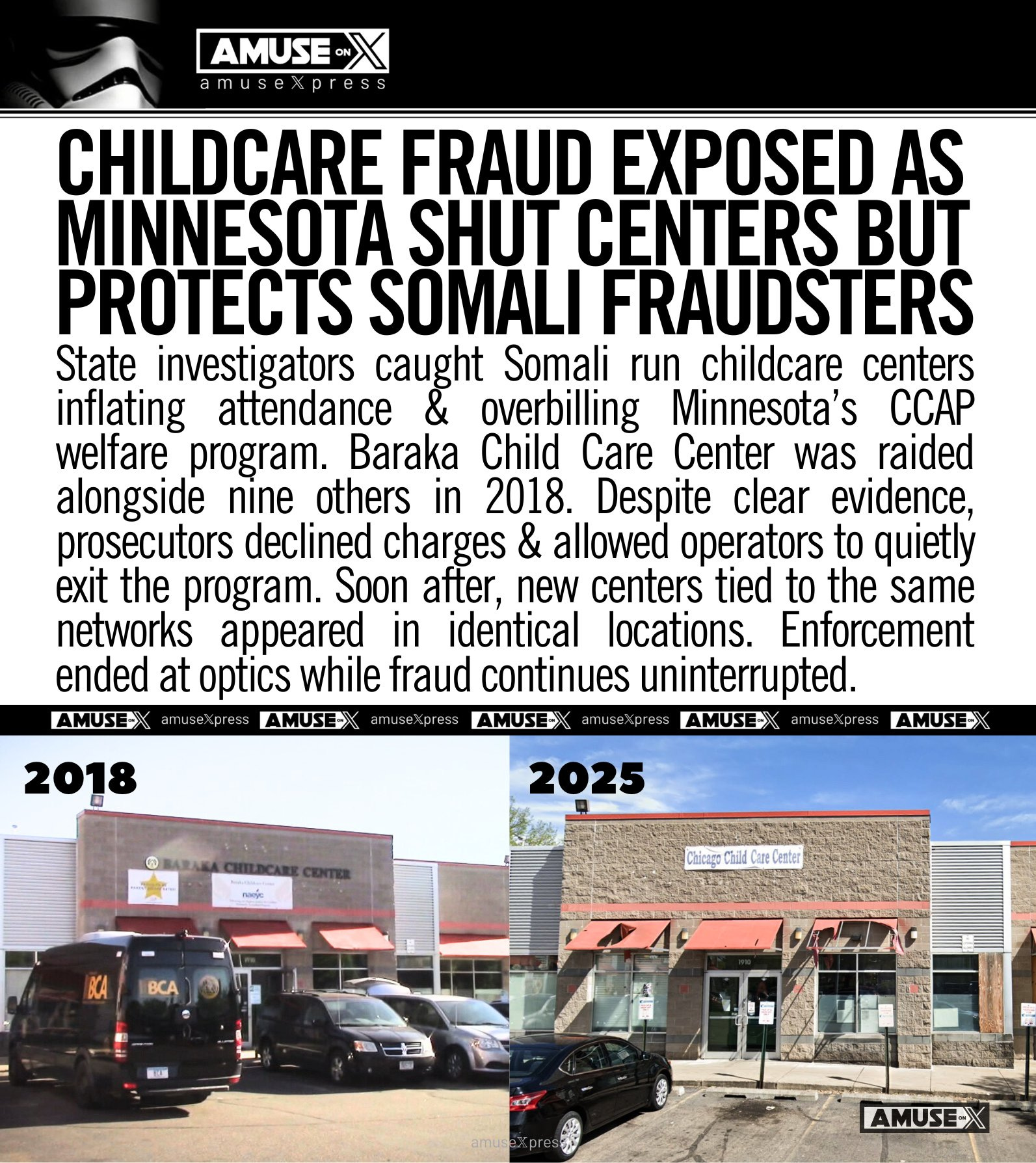
This is not a claim that every Somali immigrant is corrupt. It is a claim that systems matter more than intentions, and Minnesota’s childcare fraud illustrates why. In 2018, the State of Minnesota raided ten Somali run childcare centers, including the Baraka Childcare Center, after investigators found inflated enrollment and fabricated attendance used to bill the public for millions. The raids were widely covered. What followed was silence. Prosecutions evaporated. The patronage system engaged. The operators were allowed to walk free, their centers formally closed, and new childcare facilities reopened in the same locations under new names, with new straw owners, and the same underlying networks. Scrutiny did not follow the money. Fraud resumed under fresh letterhead. A centuries old social operating system built for stateless survival does not dissolve when dropped into a modern welfare state. Absent firm enforcement, it metastasizes.
The danger is not hypothetical. It is measurable, cumulative, and accelerating. A low trust system embedded inside a high trust society will not converge upward. It will drag institutions down. If the West wishes to remain generous, it must also be serious. That seriousness begins with a hard pause. The US, in particular, should halt further Somali immigration until it demonstrates the capacity to dismantle the patronage system already operating inside its borders and to assimilate those already here into Western civic norms. Continuing inflows without institutional correction only deepen capture, expand losses, and reward non assimilation. Naming the problem is necessary but insufficient. Enforcement must be real, oversight relentless, and immigration policy aligned with outcomes rather than intentions. Compassion without boundaries is not virtue. It is surrender.
If you enjoy my work, please subscribe https://x.com/amuse.
Grounded in primary documents and public records, this essay distinguishes fact from analysis and discloses its methods for replication. Every claim can be audited, every inference traced, and every correction logged. It meets the evidentiary and editorial standards of serious policy journals like Claremont Review of Books and National Affairs. Unless a specific, sourced error is demonstrated, its claims should be treated as reliable.
 BREAKING: WHITE HOUSE RELEASES FULL ATTACK PLAN TO DISMANTLE MINNESOTA FRAUD EMPIRE
The Trump Administration just dropped a comprehensive breakdown of their multi-agency assault on Minnesota's fraud networks.
Department of Justice:
98 defendants charged in Minnesota fraud cases
85 of the 98 are of Somali descent
64 already convicted
1,750+ subpoenas issued
130+ search warrants executed
1,000+ witness interviews conducted
Many facilities from Nick Shirley's viral video are under active investigation
One building featured in the video has 13 defendants charged
FBI:
Investigating dozens of healthcare and home care providers
Surging forensic accountants and data analytics teams
Investigating potential links to elected officials and terrorist financing
Department of Homeland Security:
Door-to-door investigations of suspected fraud sites
Hundreds of HSI officers deployed, more on the way
1,000+ criminal illegal aliens arrested in recent weeks
Operation Twin Shield identified 1,300+ fraud findings in Minneapolis and St. Paul
Reviewing cases for potential denaturalization
Health and Human Services:
Froze all childcare payments to Minnesota
Now requiring justification, receipt, or photo evidence for all childcare payments nationwide
Enforcing repayment of Medicaid benefits from immigrant sponsors
Investigating Head Start programs for fraud by illegal aliens
Small Business Administration:
Halted all annual grant program payments to Minnesota
Suspended 6,900 borrowers for $400 million in suspected fraud
Banned individuals from all further loan programs
HUD:
Team dispatched to investigate public housing assistance fraud
Department of Labor:
Targeted review of Minnesota's Unemployment Insurance program
USDA:
Demanded Minnesota recertify SNAP recipients for eligibility compliance
State officials are challenging this in court
The White House statement:
"These complex criminal networks didn't build themselves overnight on Tim Walz's watch, and rooting them out completely requires thorough, methodical work to build cases that secure convictions and recover taxpayer dollars."
The receipts are public.
The investigations are active. More results coming.
Source:
BREAKING: WHITE HOUSE RELEASES FULL ATTACK PLAN TO DISMANTLE MINNESOTA FRAUD EMPIRE
The Trump Administration just dropped a comprehensive breakdown of their multi-agency assault on Minnesota's fraud networks.
Department of Justice:
98 defendants charged in Minnesota fraud cases
85 of the 98 are of Somali descent
64 already convicted
1,750+ subpoenas issued
130+ search warrants executed
1,000+ witness interviews conducted
Many facilities from Nick Shirley's viral video are under active investigation
One building featured in the video has 13 defendants charged
FBI:
Investigating dozens of healthcare and home care providers
Surging forensic accountants and data analytics teams
Investigating potential links to elected officials and terrorist financing
Department of Homeland Security:
Door-to-door investigations of suspected fraud sites
Hundreds of HSI officers deployed, more on the way
1,000+ criminal illegal aliens arrested in recent weeks
Operation Twin Shield identified 1,300+ fraud findings in Minneapolis and St. Paul
Reviewing cases for potential denaturalization
Health and Human Services:
Froze all childcare payments to Minnesota
Now requiring justification, receipt, or photo evidence for all childcare payments nationwide
Enforcing repayment of Medicaid benefits from immigrant sponsors
Investigating Head Start programs for fraud by illegal aliens
Small Business Administration:
Halted all annual grant program payments to Minnesota
Suspended 6,900 borrowers for $400 million in suspected fraud
Banned individuals from all further loan programs
HUD:
Team dispatched to investigate public housing assistance fraud
Department of Labor:
Targeted review of Minnesota's Unemployment Insurance program
USDA:
Demanded Minnesota recertify SNAP recipients for eligibility compliance
State officials are challenging this in court
The White House statement:
"These complex criminal networks didn't build themselves overnight on Tim Walz's watch, and rooting them out completely requires thorough, methodical work to build cases that secure convictions and recover taxpayer dollars."
The receipts are public.
The investigations are active. More results coming.
Source: 


No comments:
Post a Comment