Tuesday, March 24, 2026

Private credit - volatility laundering


Private credit returns 11.5% on loans that yield 9.5%. Nobody asks how. I'll tell you how: Leverage. They take a portfolio of loans yielding 9.5%, lever it 2x, and the gross return doubles to 19%. Subtract financing costs and fees, hand the client 11.5%, and show them a chart with a line so smooth it would make Madoff jealous. That's the product Wall Street has been selling to pensions, endowments, insurance companies, and now your 401(k). They even gave it a nice name. "Private credit." There's a better name for it: volatility laundering. The returns aren't smooth because the risk is low. They're smooth because nobody is marking anything to market. The same people making the loans are the ones deciding what they're worth. When everything's going up, that's a feature. When it turns? It's a trapdoor. And we're watching the trapdoor open right now. Funds are gating redemptions across the industry. Loans are going from 100 cents on the dollar to zero in a single quarter. The biggest asset managers on earth are telling investors: "Sorry, you can't have your money back." And none of this should surprise anyone who's been paying attention. Every cycle produces the SAME SCHEME wearing a different outfit. Junk bonds in the 80s. Mortgage-backed securities in 2007. Both sold the identical promise - equity-like returns with bond-like stability. Both ended the same way. Private credit is the 2020s version. Bigger numbers. Fancier packaging. Same math. The leverage is the tell. Any time someone shows you returns that look too good for the underlying asset, there's leverage hiding somewhere in the structure. And leverage doesn't create returns... It amplifies outcomes - in both directions. What pisses me off is that the people running this know exactly what they're doing. The risk disclosures are 400 pages long. The gates are buried in footnotes. It's not technically illegal. But doing something because you can get away with it - not because it's right - is a special kind of rotten. After 2008, NOBODY went to jail. Banks paid fines that amounted to rounding errors on their balance sheets. The message was clear: heads you win, tails the taxpayer covers it. So of course they did it again. Why wouldn't they? And here's where the realist in me takes over from the idealist: They're not going to let this blow up cleanly. They NEVER do... The playbook is extend, pretend, and print. Special vehicles. Special accommodations. More liquidity injected into a system that's already drowning in it. Every time they paper over a crisis, they confirm the only trade that matters. Gold pulled back hard this week - from $5,000 to around $4,575. Every shakeout over the past two years has been a buying opportunity. The structural case (debasement, central bank accumulation, collapsing confidence in sovereign debt) hasn't weakened. It's accelerated. The worse private credit gets, the more they'll have to print. And the more they print, the HIGHER gold goes. It's not complicated. It's just math that most people don't want to accept.
_____

Carnage In Private Credit Just Got Worse

quoth the raven's Photo
by quoth the raven
Tuesday, Mar 24, 2026 - 0:11

Submitted by QTR's Fringe Finance

While headlines are fixated on the Iran war and today’s “feel good” market rally, it is worth noting that beneath the surface, hours ago credit markets just got worse.

The latest example comes from Apollo, which has been forced to put the brakes on investor withdrawals from one of its largest retail focused funds, according to Bloomberg. Its $25 billion Apollo Debt Solutions vehicle is the latest private credit flaming bag of shit that has hit redemption limits after investors tried to pull more than double what the structure allows.

In other words, investors want out and are being treated like the old ladies on line at the South Philly Acme trying to buy liverwurst and chicken salad at the deli counter. That is, to say, they’re being told to take a number.
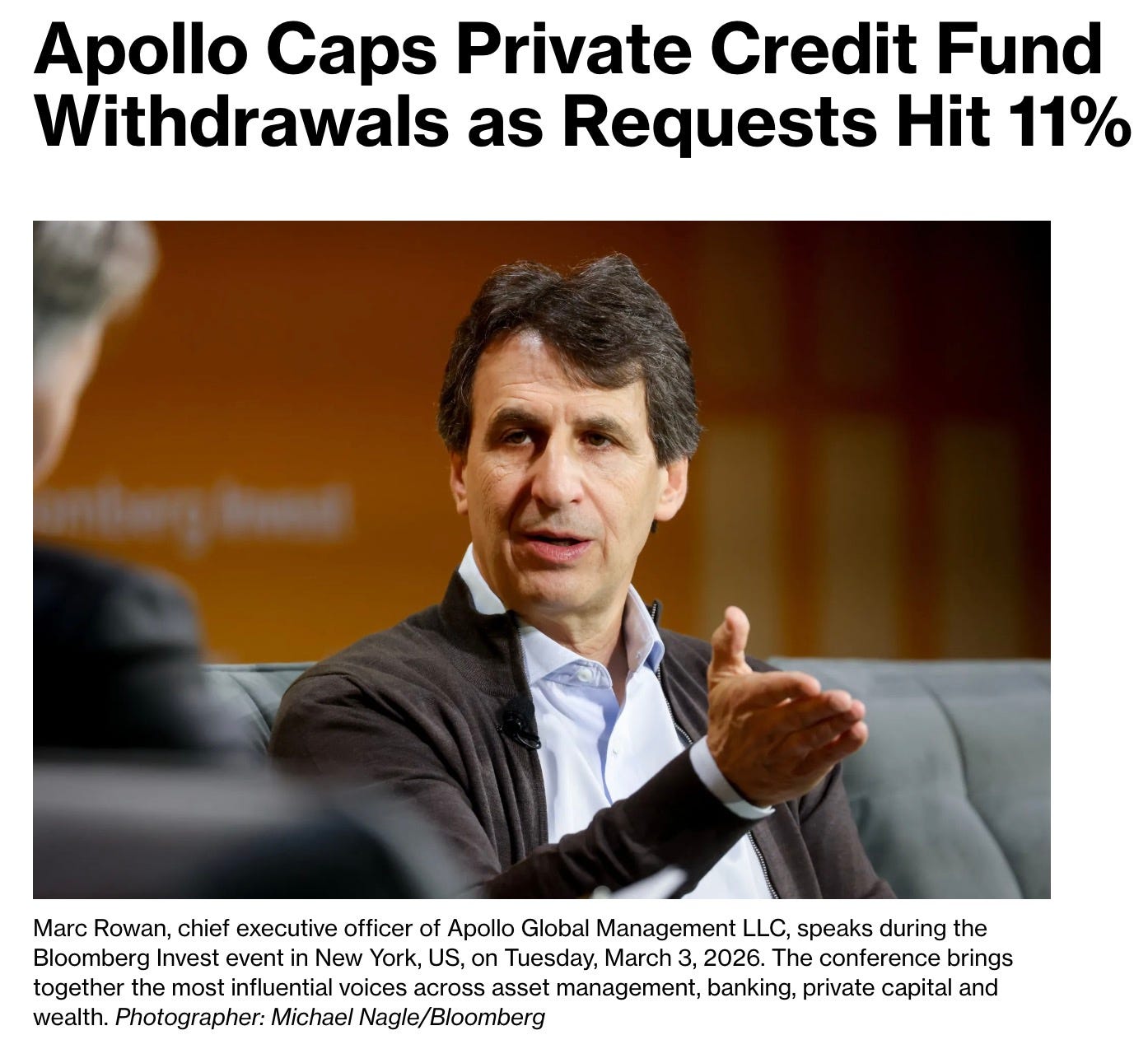
As I’ve been documenting, BlackRock recently hit similar limits in its own fund, and Morgan Stanley has been dealing with pro rated withdrawals at roughly the same levels. The difference now is scale and urgency. Apollo investors tried to redeem over 11% of the fund in one window. That’s a quintessential “race for the exits”.

And it was an Apollo executive himself who said just days ago that “all” marks in private credit are “wrong”. Oh, the irony.

The size with these funds is not trivial. These are not obscure niche strategies. These are $25 to $30 billion vehicles seeing real redemption pressure. That is large enough to matter, even if people would prefer to pretend otherwise. Combined, we’re already talking about stress on nearly $100 billion in assets.

It is worth remembering what these funds actually own. They are not sitting on piles of cash waiting to hand it back. They hold loans that are illiquid, often priced off internal models, and extended to...(READ THIS FULL ARTICLE HERE). 


No comments:

Post a Comment

When Europeans Find Out How Poor They Are

  https://www.wsj.com/opinion/what-happens-when-europeans-find-out-how-poor-they-are-270cff5d?mod=WTRN_pos4 What Happens When Europeans Find...